
| . |
Pine Processionary
Caterpillar
Thaumetopoea
pityocampa
(Thaumetopoeidae)
| Overview |
| Shelter Building |
| Midwinter Foraging and Thermoregulation |
| Trail Making and Processionary Behavior |
| Anti-Predator Defense |
| References |
The pine processionary caterpillar is the best known of all the processionaries, studied as early as 1736 by Raumier and later by Fabre (1898) whose essay “ The life of the caterpillar” is among the classics of popular entomological literature. The insect is found in the warmer regions of southern Europe, the Near East, and North Africa. It is the habit of the caterpillars to move over the ground in long head-to-tail processions and to sting with urticating hairs anyone who attempts to molest them that has brought the caterpillars to the attention of the public. It is also one of the most destructive of forest insects, capable of defoliating vast tracts of pines during its episodic population surges. Of interest here, however, is the fact that is among the most social of caterpillars. Sibling groups stay together throughout the larvae stage, often pupating side by side at sites they reach by forming long, over-the-gound, head-to-tail processions.
The insect is active only
during
the colder times of the year, spending the warm summer months as a pupa
buried in the ground. The moths begin to emerge from the soil in
August and shortly thereafter mate and seek out pine trees where they
place
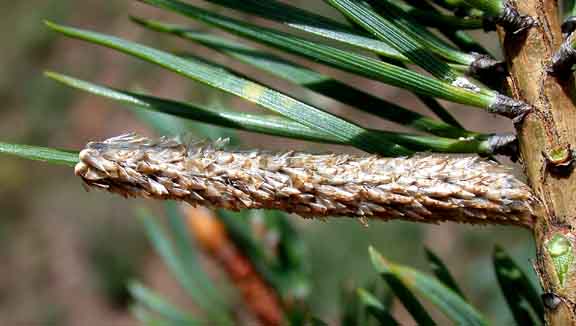
their eggs. Each female produces a single egg mass which it
fastens
to a needle of a suitable host trees. Egg masses contain up to
300
or so eggs and the caterpillars typically eclose from them four or more
weeks after they are laid. The eggs are completely covered with
scales
that detach from the abdomen of the female.
 |
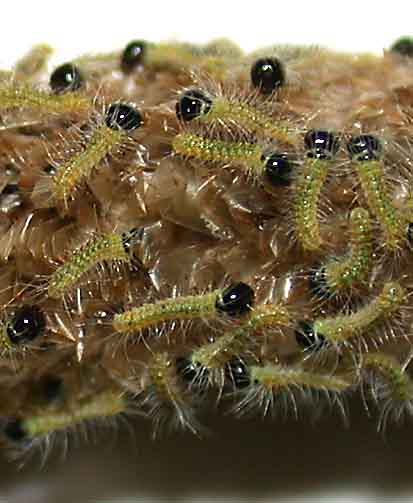 |
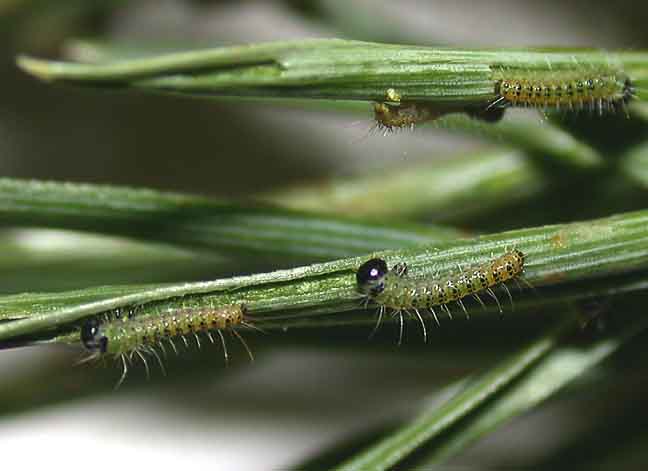
| Despite their small size, the newly hatched caterpillars have remarkably strong mandibles and are able to penetrate the tough needles of the host from the start. |
 |
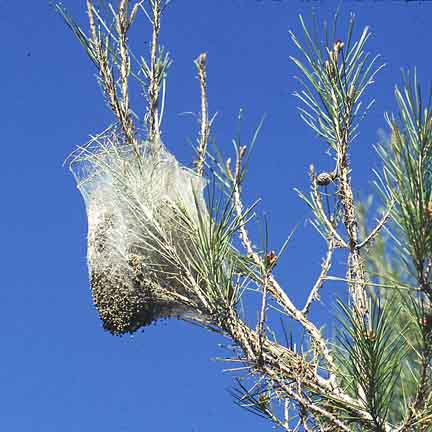
They caterpillars are highly
social.
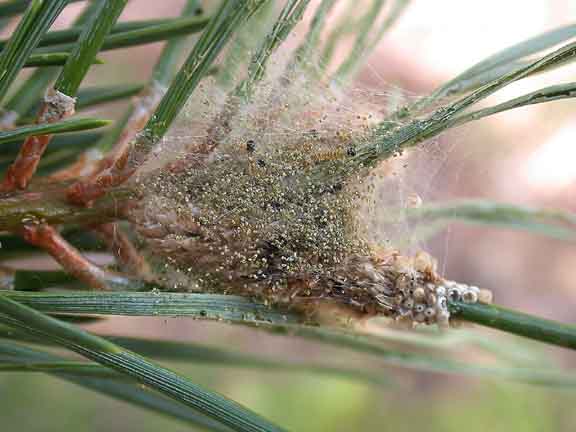
At first they are nomadic, spinning and abandoning a series of flimsy
shelters
constructed by enveloping a few needles in silk but in the third instar
they initiate the construction of a permanent nest and settle down to
become
central place foragers. There are no definitive opening in the
shelter
that allow the caterpillars to enter and exit. Rather, the caterpillars
force their way through the layers of the shelter as they move in and
out.
The frass that is produced as the caterpillars process their meals
accumulates
at the bottom of the shelter.
 |
 |
Colonies are active throughout
the
winter months. Activity records of colonies foraging in pine
forests
in mountainous regions near Barcelona, Catalonia, obtained with
infrared
activity monitors, show that the caterpillars leave their nests soon
after
sunset and travel to distant feeding sites located on the bran ches of
the host tree. Here they feed overnight then return to the nest
at
dawn. Observations in mid-winter show that the caterpillars
forage
on the coldest of nights and are able to locomote, albeit very slowly,
at sub-zero temperatures. The permanent nests are typically sited
to intercept solar radiation and during sunny days warm to well above
ambient
temperatures. The caterpillars rest in the nest during the day
and
at the elevated body temperatures they experience due to heating of the
nest by the sun are able to efficiently digest the food they collect
overnight.
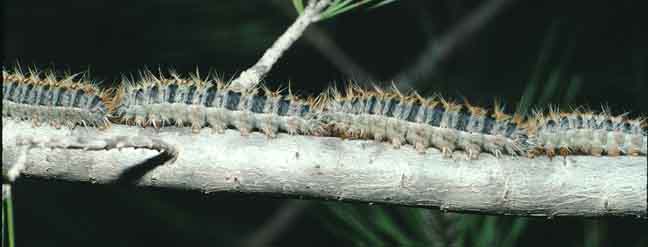
By March the caterpillara are in the fifth instar and are fully
grown.
At this time the leave their nest, following each other in long, head
to
tail processions and seek out pupation sites in the soil.
 |
 |
 |
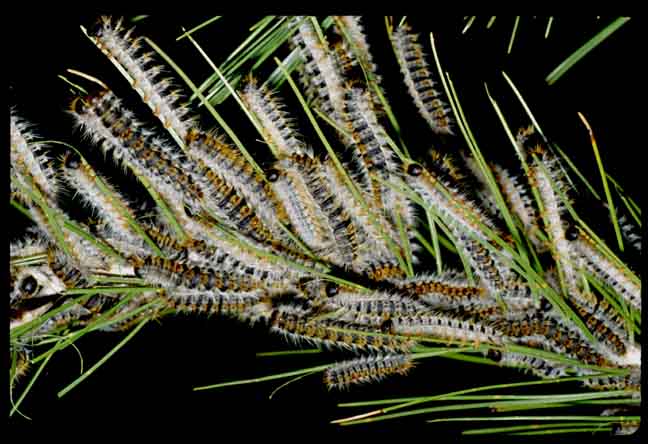 |
| Recent studies show that the caterpillars lay down a trail pheromone as they advance over the branches of the host tree. The unidentified marker is secreted from the ventral surface of the abdomen. The caterpillars mark when the tips of their abdomens brush against the substrate. Although the c aterpillars also secrete silk and mark their pathways with the material, studies show that it plays little or no role in the elicitation or maintenance of trail following. Most likely, silk serves to increase steadfastness on the smooth plant surfaces. Pine processionary caterpillars can distinguish old from new trails. They caterpillars also differentiate between trails made by different numbers of caterpillars and follow preferentially those marked by the most caterpillars. Trail marking enables the caterpillars to aggregate at feeding sites and allows them to find their way back to nest after feeding. When they move over the branches, the caterpillars may move head to tail in small groups or they may move completely independently of others. In either case, they rely on the trail marker to find their way. |
|
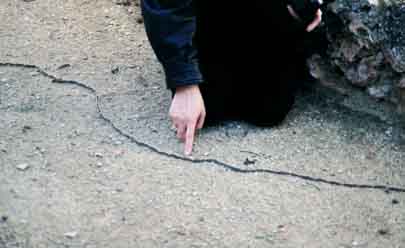
While the caterpillars may
form
single file processions as the advance over the branches of the host
tree
in search of food, the most spectacular processions are formed
when
the caterpillars are fully grown and abandon the host tree in search of
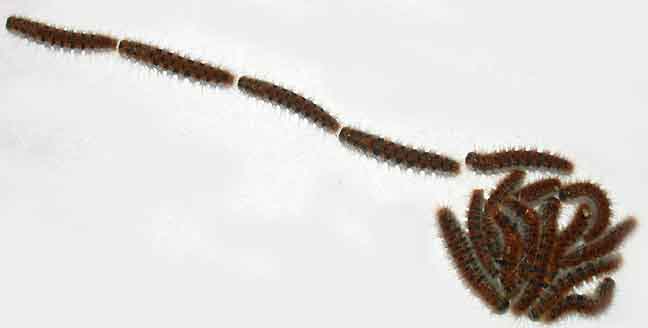
pupation sites. Over-the-ground processions of as many as three
hundred
caterpillars have been observed. The caterpillars may travel long
distances from the natal tree looking for soft soil in which they bury
themselves an d form their cocoons.
 |
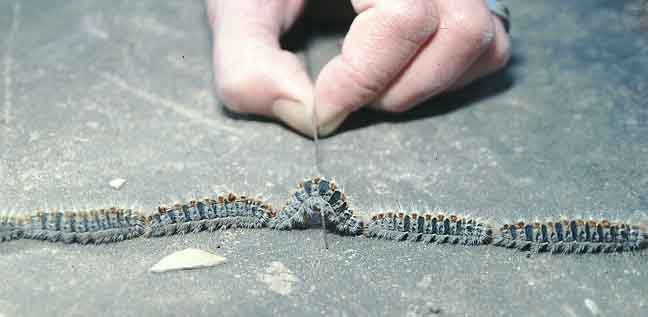 |
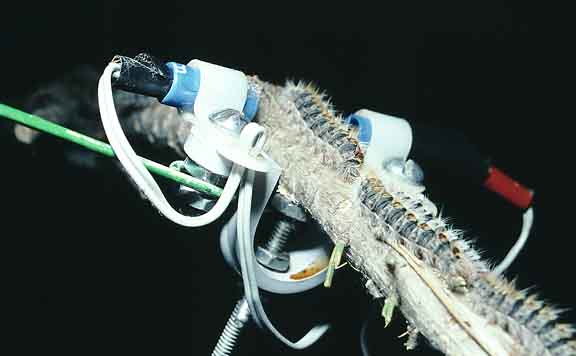
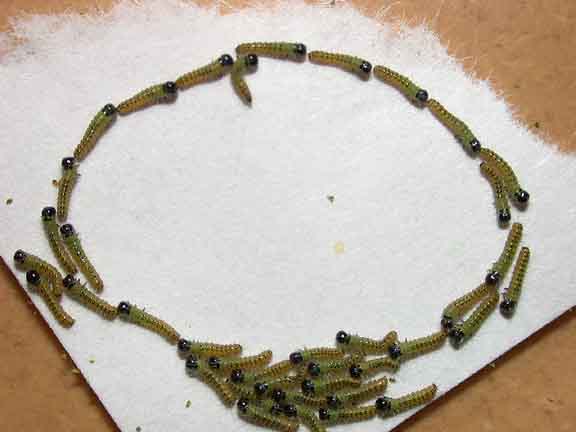
| Studies show that during these head to tail processions, stimuli associated with setae found on the tip of the abdomen of the precedent caterpillar serve to hold processions together and such stimuli take priority over those associated with either the trail pheromone or silk. A caterpillar can be readily induced to follow a model made by attaching the integument of the abdomen of a killed caterpillar to a wooden dowel . | 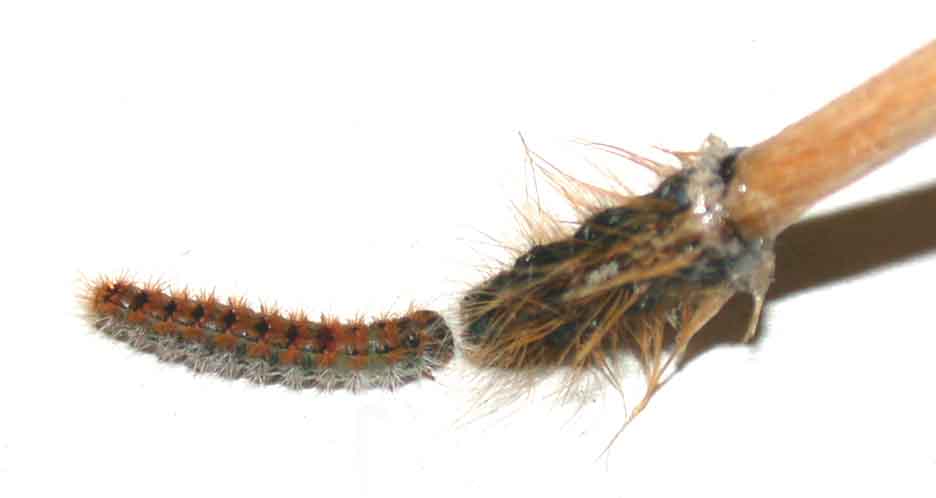 |
 |
 |
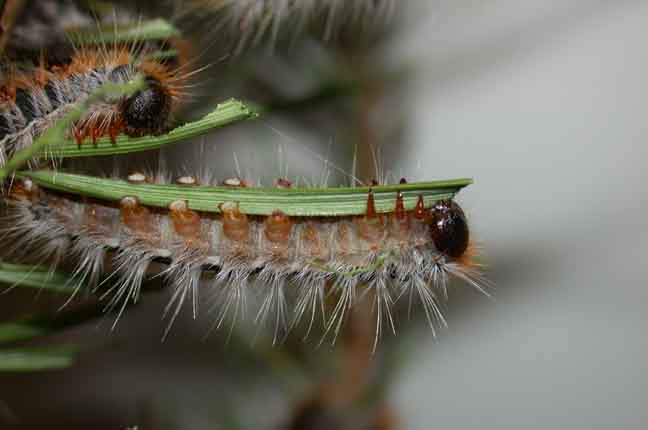
| The caterpillars of the pine processionary are highly urticating in the third and subsequent instars. Contact with the hairs causes skin rashes and eye irritations. Susceptible individuals may also develop an allergic response to a protein associated with the hairs of the caterpillar. | 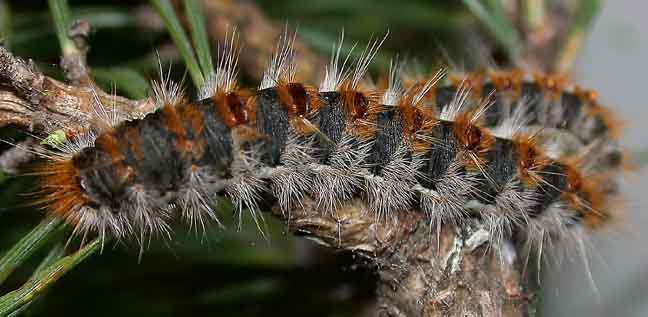 |
Brindley, H. H. 1910. Further notes on the procession of Cnethocampa pinivora. Proc. Cambridge Phil. Soc. 15:576-587.
Dajoz, R. 2000. Insects and Forests. The Role and Diversity of Insects in the Forest Environment. Lavoisier publishing, Paris.
Demolin, G. 1962. Comportement des chenilles de Thaumetopoea pityocampa au cours des processions de nymphose. C. R. Acad. Sci. 254:733-744.
Demolin, G. 1971. Incidences de quelques facteurs agissant sur le comportment social des chenilles de Thaumetopoea pityocampa Schiff. (Lepidoptera) pendant la période des processions de nymphose. Répercussion sur l’efficacité des parasites. Ann. Zool. –Ecol. anim., no hors série: 33-56.
Ducombs, G., Lamy, M., Mollard, S., Guillard, J. M., and Maleville, J. 1981. Contact dermatitis from processional pine caterpillar (Thaumetopoea pityocampa Schiff., Lepidoptera). Contact Dermatitis 7:287-288.
Edwards, T. G. 1910. On the procession and pupation of the larva of Cnethocampa pinivora. Proceedi ngs of the Cambridge Philosophical Society 15:431-436.
Fabre, J. H. 1898. Souvenirs Entomologiques, sér. 6:298-392.
Fabre, J. H. 1916. The Life of the Caterpillar. Dodd, Mead and Co. Inc., New York.
Fitzgerald, T. D. 2003. The role of a trail pheromone in the foraging and processionary behavior of Thaumetopoea pityocampa. J. Chem. Ecol. in press.
Fitzgerald, T. D. 2008. Lethal
Fuzz. Natural History Magazine 117:28-33 (September) also:
http://www.naturalhistorymag.com/master.html?http://www.naturalhistorymag.com/0908/0908_feature.html
Halperin. J. 1990. Life history of Thaumetopoea spp. (Lep., Thaumetopoeidae) in Israel. J. Appl. Ent. 110:1-6.
Lamy, M., Pastureaud, M-H., Novak, F., Ducombs, G., Vincendeau, P., Maleville, J., and Texier, L. 1986. Thaumetopoein: an urticating protein from the hairs an integument of the pine procession catepillar (Thaumetopoea pityocampa Schi ff., Lepidoptera,Thaumetopoeidae). Toxicon 24:347-356.
Mallmann, R. J. 1962. Observations sur les réactions tactiles de la chenille processionnaire du pin, Thaumetopoea pityocampa Schiff. Insectes sociaux 9:335-345.
Réaumur, M. 1736. Mémoires pour l'histoire des Insectes, II. Paris.
Vega, J. M., Mo neo, I.,
Armentia,
A., Fernández, J., Vega, J., De La Fuente, R., Sanchez, P., and
Sánchís, E. 1999. Allergy to the pine processionary
caterpillar (Thaumetopoea pityocampa). Clinical and
Experimental
Allergy 29:1418-1423.